
Sixense’s Sissterra® solution is an advanced geophysical technology designed to provide a detailed, three-dimensional understanding of the subsurface. Developed from techniques used in academia and the oil and gas industry, it enables engineers and project teams to “see” underground conditions without intrusive drilling or excavation.
At its core, Sissterra® delivers 3D visualisation of soil and geological structures, helping users better understand what lies beneath a site and manage associated risks before and during construction projects.
What makes Sissterra® distinctive is that it is a non-destructive and passive seismic solution. Instead of generating artificial seismic waves (as in traditional surveys), it relies on naturally occurring ambient vibrations—such as those produced by traffic, machinery, or human activity. This makes it particularly suitable for dense urban environments where conventional methods can be disruptive, costly, or impractical. By avoiding invasive techniques like boreholes or active seismic sources, the system can be deployed quickly and with minimal impact on ongoing operations.
The way Sissterra® works is based on a principle called seismic interferometry. A network of small, autonomous geophone sensors is placed across the area of interest. These geophones record ambient seismic noise over time, generating large volumes of data. This data is then processed using advanced signal-processing algorithms to extract meaningful information about subsurface structures. By analysing correlations between signals recorded at different sensors, the system reconstructs a 3D model of the ground, often referred to as seismic tomography, and can even track how conditions evolve over time.
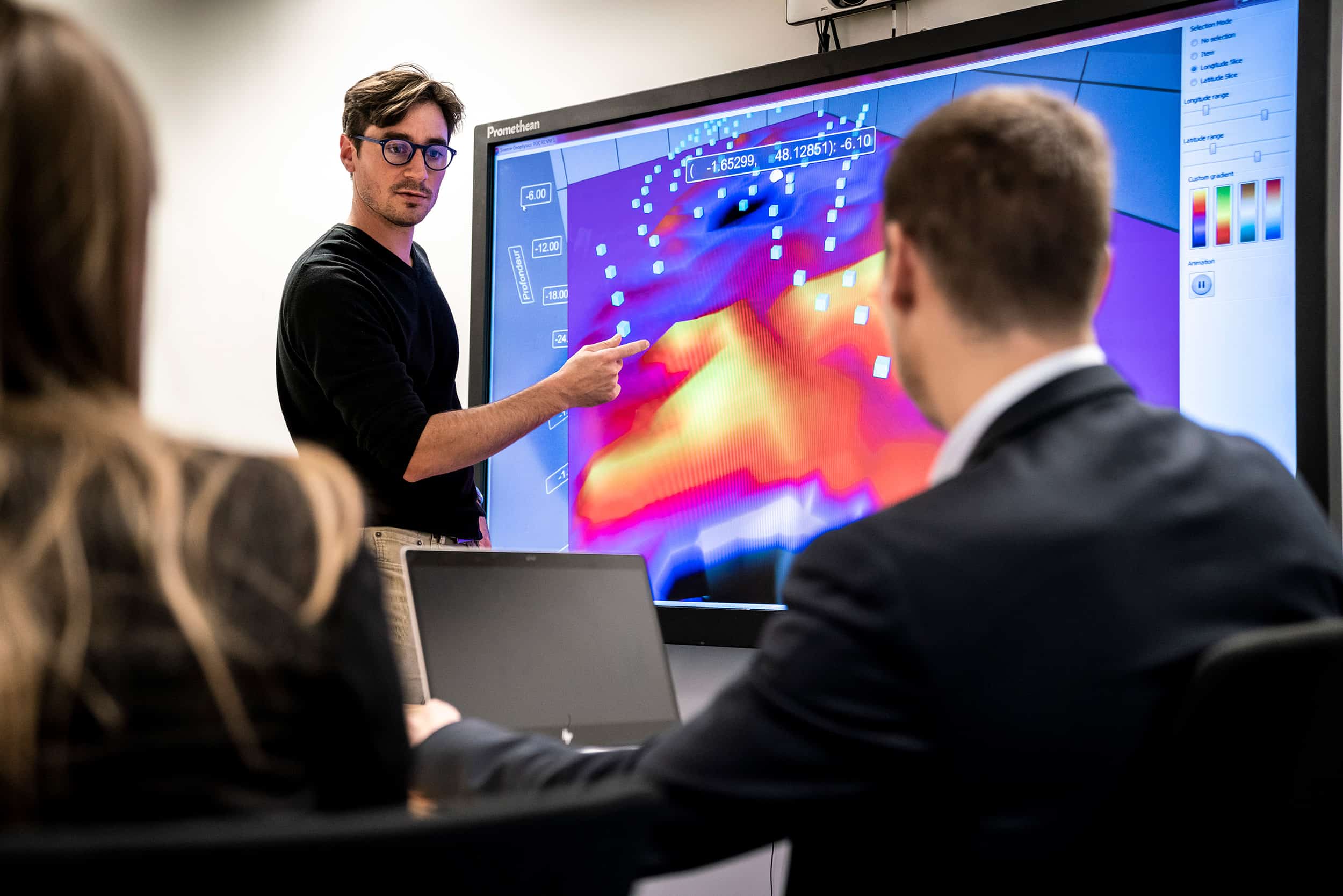
In practical terms, Sissterra® is used as a decision-support tool in engineering and construction projects. It helps refine geological models, identify potential hazards (such as voids, weak soils, or heterogeneities), and optimise construction methods. Because it provides continuous or repeatable monitoring, it can also track changes in the ground during works—allowing engineers to adjust techniques in real time. This leads to improved safety for both infrastructure and people, as well as better control over project risks and uncertainties.
The solution is particularly valuable in applications such as tunnelling, underground construction, urban infrastructure projects, and soil improvement works. For example, it can be used to plan and monitor metro tunnels, assess ground treatment effectiveness, or reduce the number of required boreholes.
Sissterra® helps organisations optimise costs, enhance safety, and make more informed decisions by providing a clearer and more dynamic picture of the subsurface environment.
