
Load Measurement in Prestressing Bars and Bolts
Sixense’s Upus® (Ultrasonic Pulse System) is an advanced non-destructive testing technology designed to accurately measure the tensile load in prestressing bars, rods, and bolts. It plays a critical role in ensuring the safety, reliability, and long-term performance of structures that rely on prestressed elements for stability and strength.
Prestressing bars and threaded rods are widely used in civil engineering and construction to assemble structural components and to introduce controlled forces that enhance load-bearing capacity. These elements are commonly found in bridges, tunnels, dams, anchoring systems, and large mechanical assemblies.
Because they are placed under high tension, any loss of force—whether due to relaxation, corrosion, creep, or mechanical loosening—can compromise structural integrity and potentially lead to serious safety risks. For this reason, periodic verification of the actual force within these components is essential.
Upus® addresses this need by using the principles of ultrasonic wave propagation. The method relies on the fact that the speed at which ultrasonic waves travel through a material is influenced by the stress state of that material. When a bar is under tension, its internal structure changes slightly, affecting the velocity of sound waves passing through it. By precisely measuring the travel time of an ultrasonic pulse along the length of a bar, Upus® can determine the level of tensile load with high accuracy.
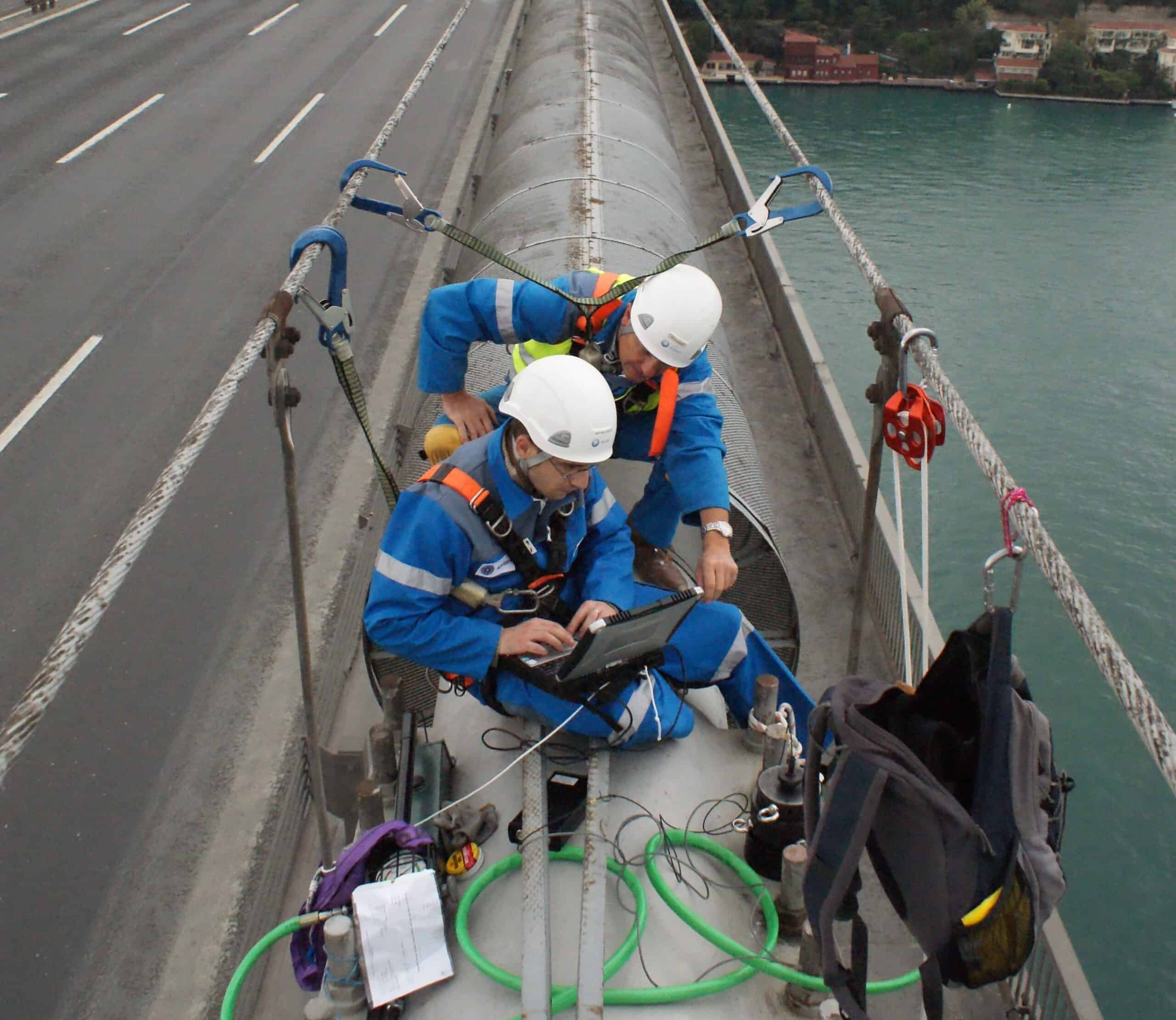
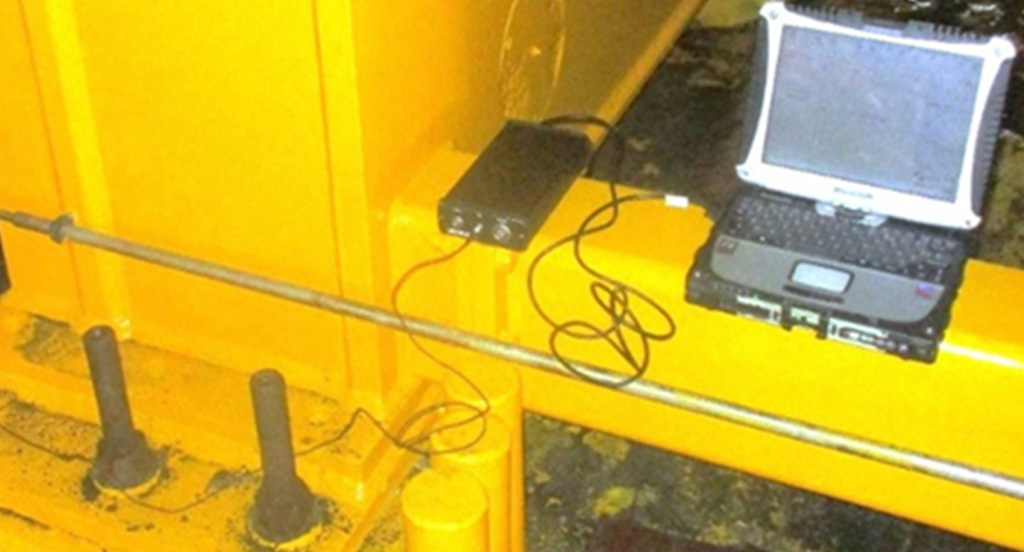
In practice, the process involves placing a compact ultrasonic transducer (sensor/receiver) on one accessible end of the prestressing bar or bolt. The device emits an ultrasonic pulse that travels through the bar, reflects off the opposite end, and returns to the sensor.
By analysing the round-trip travel time and comparing it to calibrated reference values, the system calculates the axial force within the element. One of the key advantages of Upus® is that it requires access to only a single end of the bar, making it especially useful in situations where the opposite end is embedded in concrete or otherwise inaccessible.
The measurement process is quick, repeatable, and entirely non-invasive—no need to dismantle components, release tension, or interrupt operation. This allows engineers to perform inspections on in-service structures without causing downtime or compromising safety.
The applications of Upus® are broad and span multiple industries. In civil engineering, it is used for monitoring prestressing forces in bridge cables, ground anchors, retaining structures, and post-tensioned systems. In underground construction, it helps ensure the stability of rock bolts and tunnel reinforcements. In energy and infrastructure projects, it is applied to critical bolted assemblies where maintaining correct preload is essential. Additionally, Upus® can be used during installation phases to verify that the intended prestress has been correctly applied, as well as during maintenance inspections to detect any loss of tension over time.
Sixense’s Upus® technology provides a reliable, efficient, and precise solution for load measurement in prestressed components. By enabling early detection of force variations, it helps prevent structural failures, supports maintenance planning, and contributes to the long-term safety and performance of critical infrastructure.