
Client:

Project Owner:
Converting Victorian twin tunnels for modern day use
Crossrail is a major new railway, 73 miles in length, that will link Berkshire and Buckinghamshire, via Greater London, to Essex and Kent. Ten-car trains will run at frequencies of up to 24 trains per hour in each direction through the central tunnel section. The central section of the Crossrail route will run via Paddington, Tottenham Court Road, Farringdon, Liverpool Street and Whitechapel stations.
The Crossrail C315 project was a highly distinctive contract within the wider Crossrail programme, centred on the refurbishment and reconstruction of the Victorian Connaught Tunnel in east London.
Rather than delivering a new tunnel, Crossrail C315 focused on re‑using and adapting existing tunnel infrastructure first opened in 1878, which runs for around 550 metres beneath the Royal Docks between Custom House and North Woolwich.
Awarded to VINCI Construction UK (trading as Taylor Woodrow), the works involved converting the original twin-bore brick tunnels into a single enlarged tunnel capable of accommodating modern Elizabeth line trains and overhead line equipment, while forming a critical link on the Abbey Wood branch of the route. The project combined heritage engineering with modern rail requirements and was regarded as one of the most complex examples of asset reuse on Crossrail due to its age, location beneath water, and interaction with dock structures.
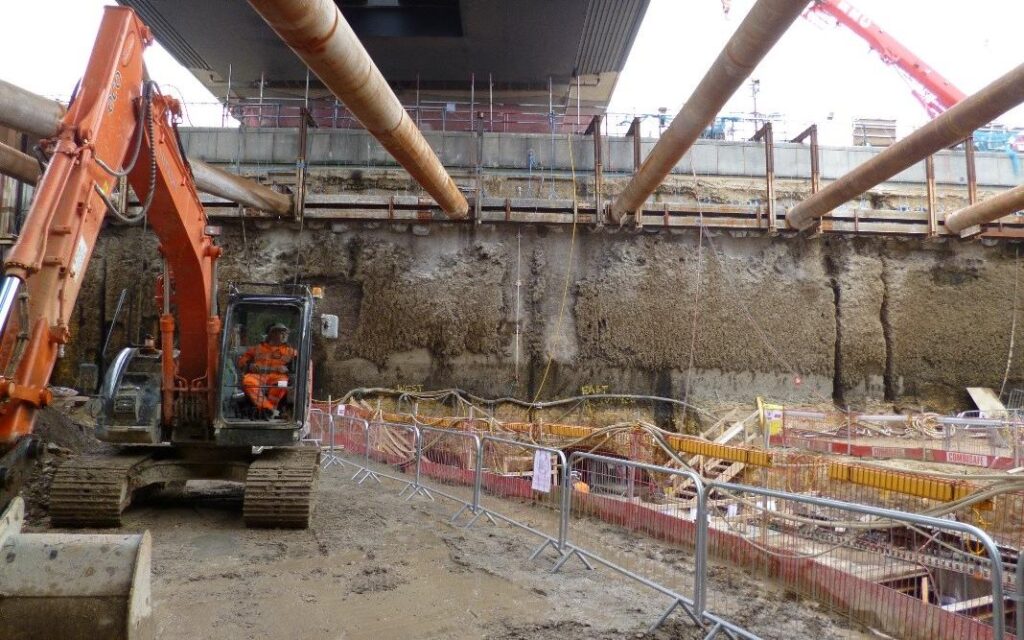
A key challenge of Crossrail C315 was managing risk and structural integrity during construction, particularly beneath the Royal Albert Dock, where sections of the works were undertaken in cofferdams and partially underwater.
Specialist techniques such as robotic demolition, precise concrete cutting, and real‑time data analysis were used to safely lower track levels, modify the tunnel invert and replace sections of historic brickwork. The successful delivery of C315 demonstrated how complex Victorian infrastructure could be safely adapted for a 21st‑century railway, providing valuable lessons in refurbishment, monitoring and risk management for future major rail schemes.
An extensive monitoring solution
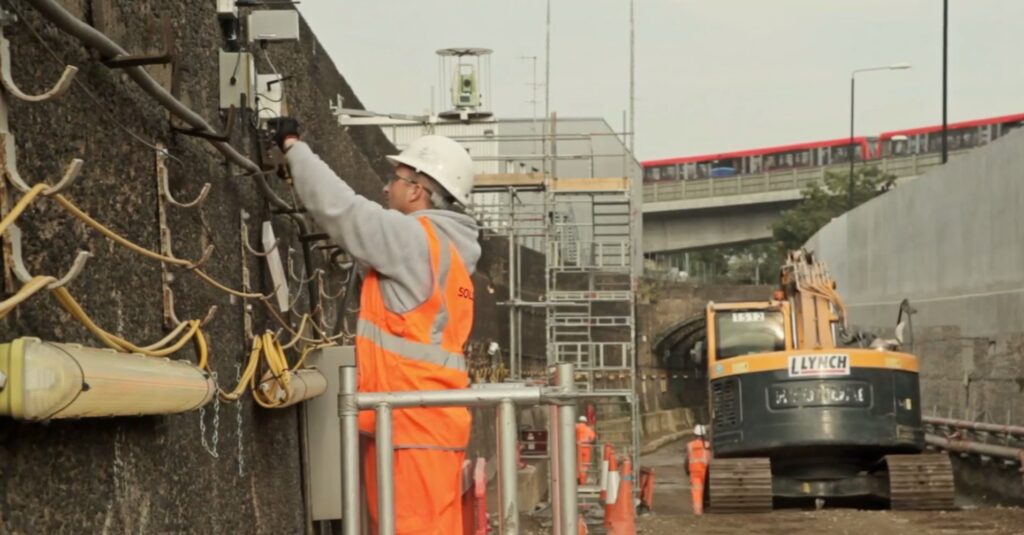
An extensive structural, geotechnical and environmental monitoring programme was deployed, including automatic total stations, load cells, tiltmeters and vibration monitoring to protect the tunnel, dock walls and surrounding utilities.
Sixense provided the structural monitoring of the tunnel and adjacent structures to the construction activities using a combination of Automatic Total Stations (ATS) working in groups, known as CYCLOPS and other traditional instrumentation.
In addition, environmental monitoring including vibration monitoring of Thames Water pipe infrastructure, and noise monitoring according to local authority statutory requirements (section 61 consents) was also provided by Sixense.
Installation by divers
Underwater instrument installations were necessary during the dewatering at the Royal Albert Docks in order to monitor the Cofferdam. Installed by specialist divers, this instrumentation provided real-time monitoring of the Cofferdam and the North and South retaining dock walls. All the data from the instrumentation was transmitted remotely which was then visualised via Sixense’s Geoscope Monitoring Software.
Sixense also provided structural and environmental monitoring in the service tunnel adjacent to the Connaught tunnel, with a series of Electrolevel beams and tiltmeters installed in the confined spaces.
To find our more about Crossrail please click here.
Images of the project
AutomaticTotal Stations (Cyclops)
Load Cells
EL Tiltmeters
Electrolevels
VW Strain Gauges


