
Client:
Jackson Civil Engineering
Jackson Civil Engineering link opens in a new tab
https://www.jackson-civils.co.uk/

Project Owner:
Network Rail Limited
Network Rail Limited link opens in a new tab
https://www.networkrail.co.uk/

A partial tunnel collapse on a live railway
The Gerrards Cross railway tunnel collapse occurred on 30 June 2005 during construction of an artificial tunnel on the Chiltern Main Line in Buckinghamshire, intended to allow a Tesco supermarket to be built over an existing open railway cutting.
While backfilling operations were taking place above the newly installed precast concrete arch units, a section of the structure suddenly failed, sending thousands of tonnes of soil and concrete onto the live railway below. A London‑bound passenger train approaching the site was forced to make an emergency stop just short of the collapse, narrowly avoiding what investigators later described as a potential multiple‑fatality disaster.
Although no one was injured, the line was closed for around seven weeks, causing significant disruption to rail services on the route to London Marylebone.
Emergency Response
After the partial collapse of the Gerrards Cross railway tunnel on 30 June 2005, Sixense (then Sol Data) were rapidly appointed by Jackson Civil Engineering and Network Rail to design and implement an emergency structural monitoring system to verify the stability of the remaining tunnel structure and enable the safe reinstatement of rail services.
Given the severity of the incident and the proximity of the collapse to a live mainline railway, the monitoring solution had to be mobilised and operational within days. We deployed an automated geodetic monitoring system based on our CYCLOPS automated total station technology, installing four CYCLOPS units inside the tunnel and targeting approximately 300 prism monitoring points across the tunnel lining and critical structural elements. The system provided continuous, real‑time 3D deformation monitoring, detecting even sub‑millimetric movements of the tunnel structure during the critical post‑collapse period.
The monitoring system was designed, installed, configured and commissioned within one week of the collapse, operating 24 hours a day with predefined alarm thresholds linked to agreed movement criteria.
Measurement data was transmitted in real time to a central processing platform, allowing on‑site engineers and remote specialists to immediately assess tunnel behaviour and confirm structural stability following debris removal and remedial works. Once Network Rail was satisfied that movements were within acceptable limits and that the tunnel was under continuous surveillance, mainline traffic on the Chiltern route was permitted to resume—significantly reducing service disruption and commercial loss while maintaining passenger safety.
The Gerrards Cross intervention became a landmark example of how rapid‑deployment automated monitoring can play a decisive role in post‑incident recovery and has since been widely cited as a reference case for emergency tunnel monitoring following structural failures.
HSE Conclusion
Subsequent investigations by the Health and Safety Executive (HSE) concluded that the failure resulted from overloading of the tunnel crown during backfilling, before sufficient support material had been placed and compacted around the tunnel haunches. This departure from the approved construction method caused excessive bending moments in the three‑pinned concrete arches, leading to the formation of plastic hinges and progressive collapse.
The incident highlighted serious deficiencies in construction sequencing, site supervision and change control, and became a landmark case study in UK civil engineering on the risks of temporary works and build‑over‑rail schemes. Although the tunnel was eventually rebuilt by different contractors and the supermarket finally opened in 2010, the Gerrards Cross collapse remains a defining example of how minor procedural deviations can trigger major structural failures in complex infrastructure projects.
New Civil Engineer provides an overview of the story from project award, tunnel collapse and the HSE report online here.
Images of the project
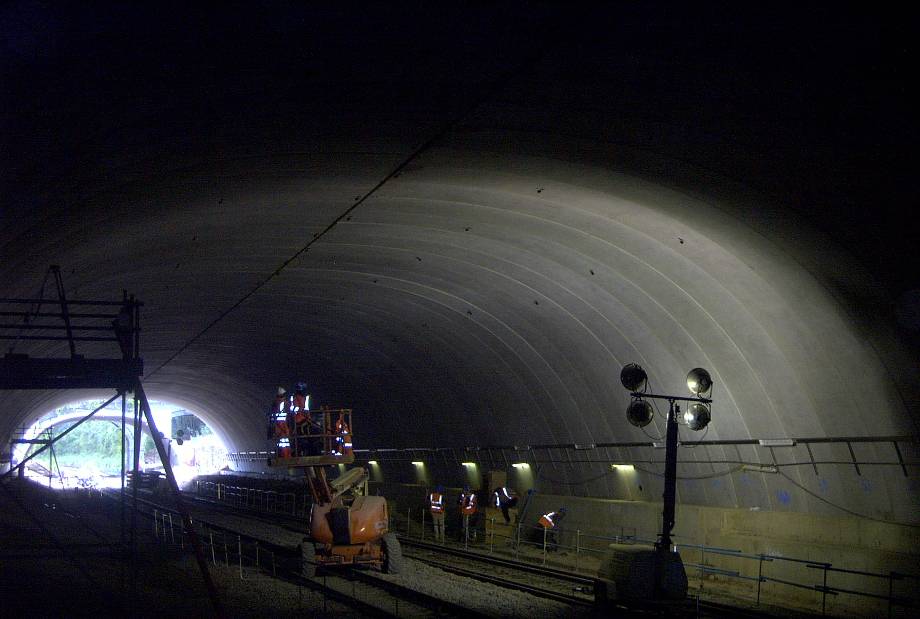
Nos. Cyclops ATS Systems
Nos. Prismatic Monitoring Targets
Remote technical support from SIXENSE HQ and web data access
Remote archiving of all data on SIXENSE’s secure server systems at SIXENSE HQ


