
Client:

Project Owner:
London Underground Limited
London Underground Limited link opens in a new tab
https://tfl.gov.uk/modes/tube/
A major transformation that has significantly enhanced one of London’s busiest transport interchanges
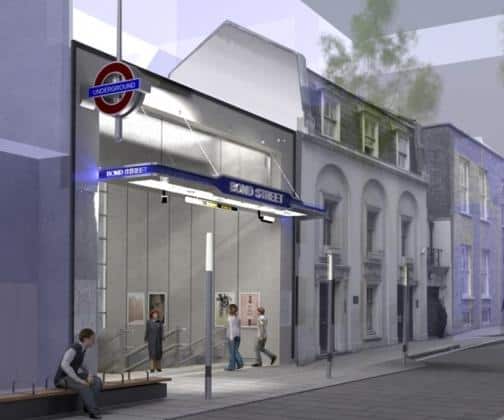
The Bond Street Station Upgrade is a major transformation that has significantly enhanced one of London’s busiest transport interchanges, driven largely by the arrival of the Elizabeth line.
Officially opened in October 2022, the upgrade delivered two brand‑new, spacious ticket halls at Davies Street and Hanover Square, providing step‑free access from street to train and directly integrating the new Elizabeth line platforms with the existing Central and Jubilee line services. The station combines modern engineering with high‑quality materials that reflect the architectural character of Mayfair, while substantially increasing capacity to help relieve congestion at nearby stations such as Oxford Circus.
Beyond transport improvements, the upgrade has acted as a catalyst for wider urban regeneration in the West End. The new Hanover Square entrance has helped unlock major mixed‑use development above and around the station, alongside improved public realm, pedestrian space and accessibility across the area.
With the station now capable of handling around 140,000 Elizabeth line journeys a day, Bond Street has become a crucial gateway linking the West End directly to destinations such as Heathrow, Canary Wharf and Paddington. The project not only future‑proofs the station for long‑term growth, but also supports retail, commercial and cultural activity by making one of London’s premier shopping districts easier to reach than ever before.
Structural, Geotechnical and Environmental Monitoring
Bond Street Station Upgrade included works to improve the connection to the Crossrail Station being built just south of the existing London Underground Station. The upgrade works to the station involved the demolition of an existing bank, the installation of secant piling, construction of new cross passages and escalator chambers below ground as well as new structures to replace the demolished structure.
The predicted zone of influence is centred around London’s West End, Stratford Place, but also encompasses Grade 1 and 2 listed structures, London Underground infrastructure and services which lie underneath the road surface.
Sixense were appointed to undertake the structural and geotechnical instrumentation as well as noise and vibration monitoring and monitoring of the surrounding structures.
Alongside this, Sixense carried out monitoring within the station and surrounding areas to ensure sensitive equipment and passengers were not exposed to excessive noise and vibration, whilst the works took place.
4D-Shape technology
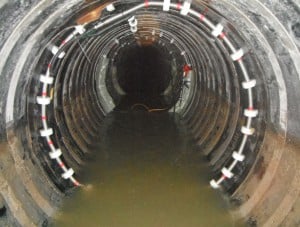
Amongst an array of automated instruments, shape arrays (SAA), known as ‘4D-Shape‘ by Sixense, were used to monitor the Central Line, east and west bound, each string containing 51 sensors, totalling 25 metres in length. The Mid Level sewer was also monitored using 4D-Shape to determine longitudinal profile and convergence/divergence.
As an integral part of the structural monitoring solution provided by Sixense on this project, data is automatically acquired and processed by data logging solutions on-site, then stored on a remote server and managed 24/7 using Sixense’s Geoscope Software which allows real-time access to monitoring data.
Images of the project
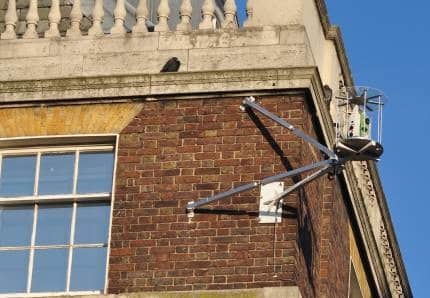
CYCLOPS / CENTAUR ATS
4D Shapes (Shape Acceleration Arrays)
Electrolevel Beams
Rod Extensometers
In-Place Inclinometers
Noise Monitoring Systems
Dust Monitoring systems


